Community heat networks
Heat recovered from the data centre is lifted where needed and fed into a local heat network, warming homes and community buildings instead of being thrown away.
A data centre can be more than a computing hall. Designed as part of the local energy system, it becomes an enabler of sustainable communities: recovered heat for homes and swimming pools, water and recreational lakes for local people, skilled jobs, net-zero power, and lower-cost energy.
Community benefits How it works
The starting point is the community around the site. The data centre is designed so that heat, water, jobs and clean energy stay close to home.
Heat recovered from the data centre is lifted where needed and fed into a local heat network, warming homes and community buildings instead of being thrown away.

The same recovered heat can warm outdoor and community swimming pools, giving local people a year-round leisure amenity powered by the campus next door.

Former landfill, quarry and dump sites can be restored as recreational lakes and public landscape. Water is managed for local communities, including irrigation and places to enjoy.

Development brings construction employment and, once operating, long-term jobs in plant operations, maintenance and local skills — work that stays in the area.

New onshore wind, firm clean backup and permanent carbon removals — biochar and direct air capture — are designed so the campus reaches net zero and then goes net-negative.
By designing wind, the data centre, useful heat and removals as one system, net-zero power is targeted at or below the cost of electricity from the grid, keeping energy affordable locally.
The community benefits rest on an integrated energy system: new onshore wind behind the meter, firm clean backup, recovered heat, rail freight where it helps, and carbon removals built into the project.
New onshore wind farms are sized at roughly three times the data centre's electrical rating and connected via private circuits. Across the year, the turbines generate far more clean electricity than the campus uses, cutting emissions sharply while exporting surplus renewable power.
Digital infrastructure needs uninterrupted, five-nines availability even during calm weather. When wind output dips, firm supply is maintained using biomass or waste-wood combined heat and power, fuel cells, battery and long-duration storage, and controlled grid top-up.
Heat from the data centre is captured and used, rather than vented to the air. It feeds community heat networks for local homes and warms outdoor and community pools. Spare heat can also serve commercial glasshouses.
Remaining emissions from backup power and lifecycle materials are balanced inside the project itself. Clean waste wood and residues are turned into stable biochar, alongside small-scale direct air capture units powered by surplus renewable electricity.
Where rail sidings are available, bulk construction materials, soil, wood feedstock and finished biochar move by train rather than heavy lorries on rural roads, easing traffic for neighbouring communities.
Integrating wind, useful heat and carbon removals is designed so that net-zero power for the campus, and lower-cost energy for the community around it, land at or below the cost of electricity from the grid.
Illustrative technical views showing how power, useful heat, rail logistics and carbon removals fit together across the year — and how they serve the community around the site.
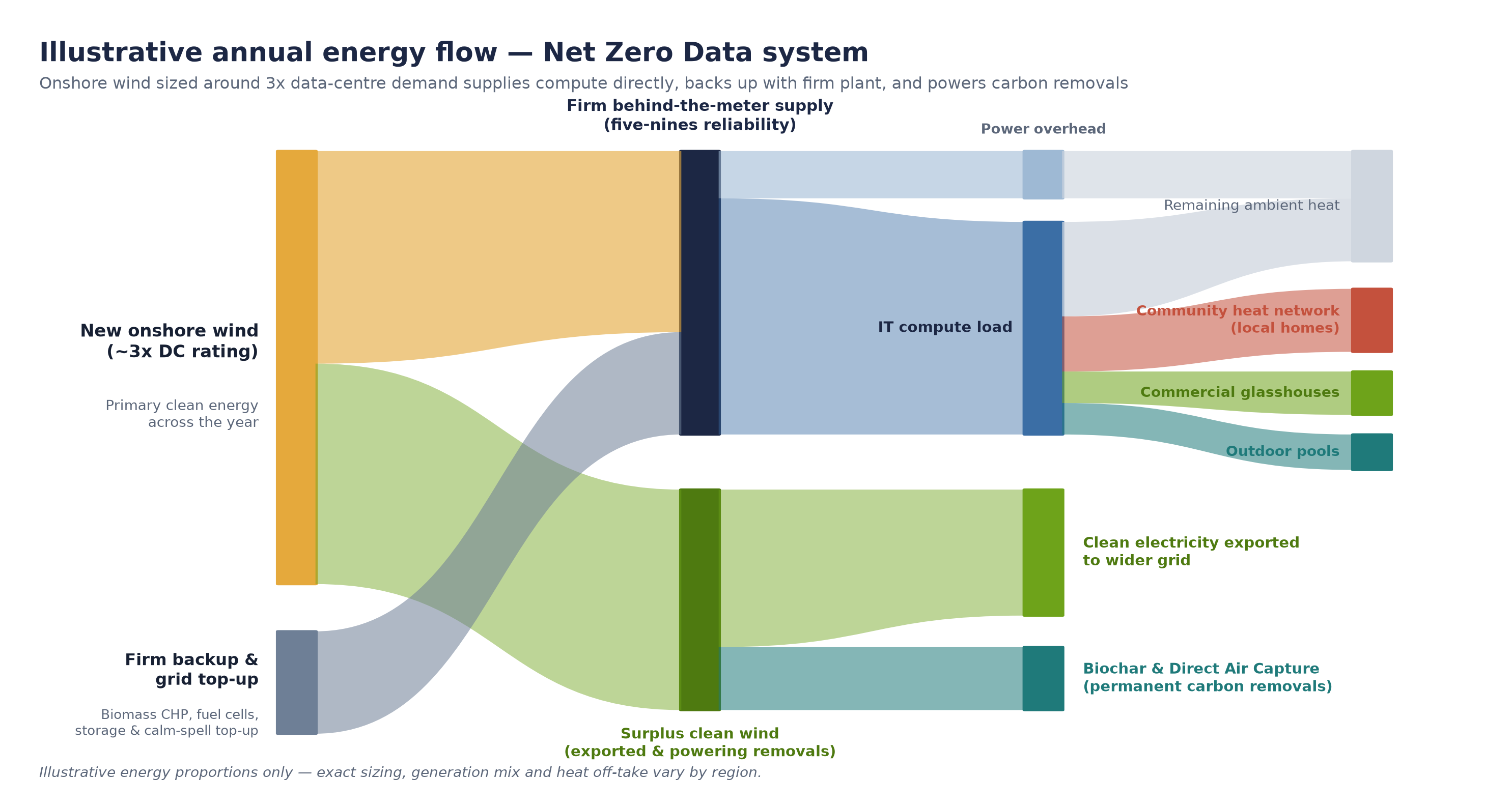
Annual energy flow. New onshore wind sized around three times data-centre demand provides the primary supply behind the meter, supported by firm backup and calm-spell grid top-up. Surplus clean electricity is exported or used to run carbon removals, while recovered heat serves homes, glasshouses and outdoor pools.
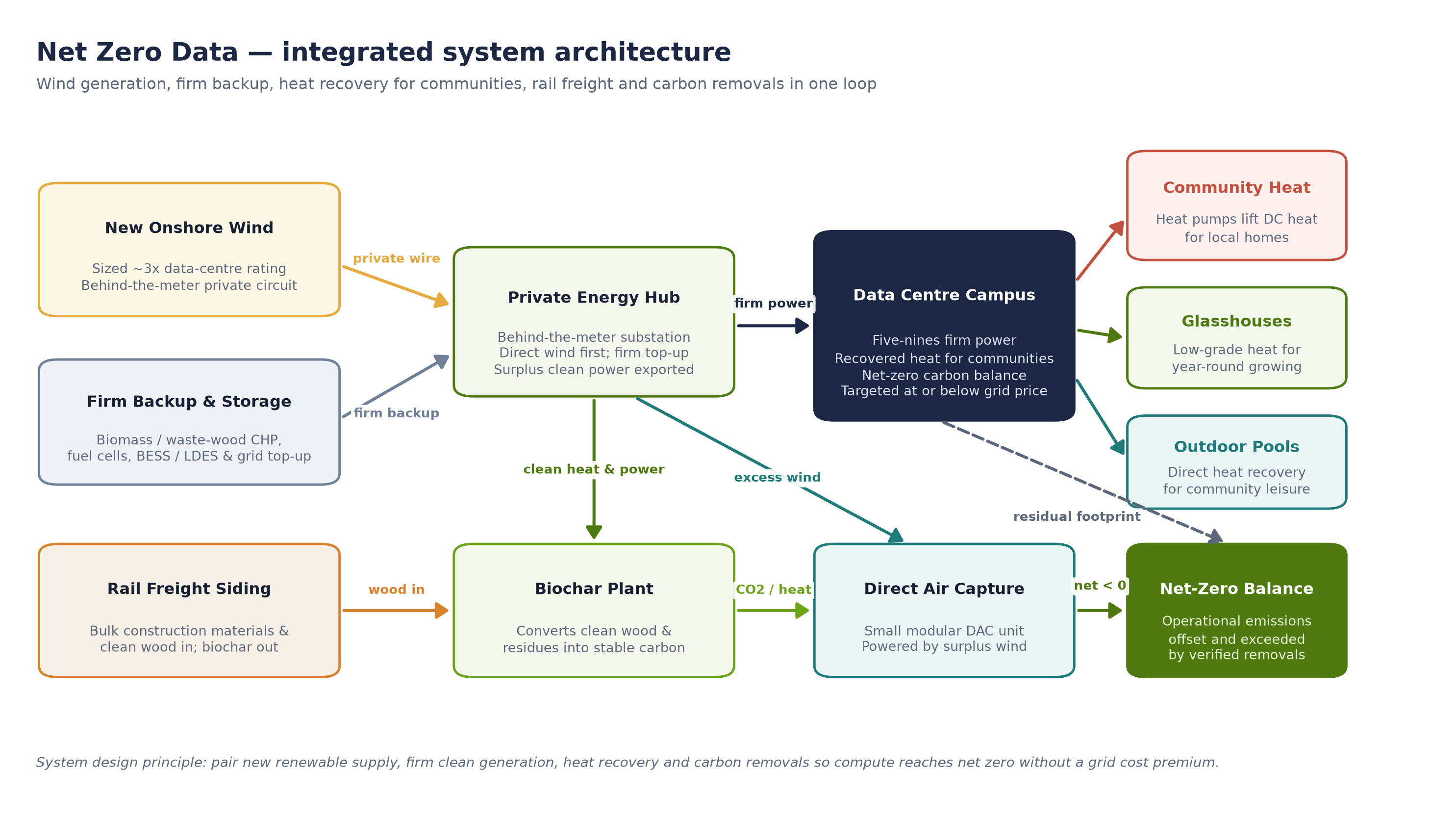
System architecture. Wind generation and firm backup feed a private energy hub; recovered heat is channelled to community users; rail sidings bring clean biomass in and move biochar out; and small direct air capture closes the remaining carbon gap.
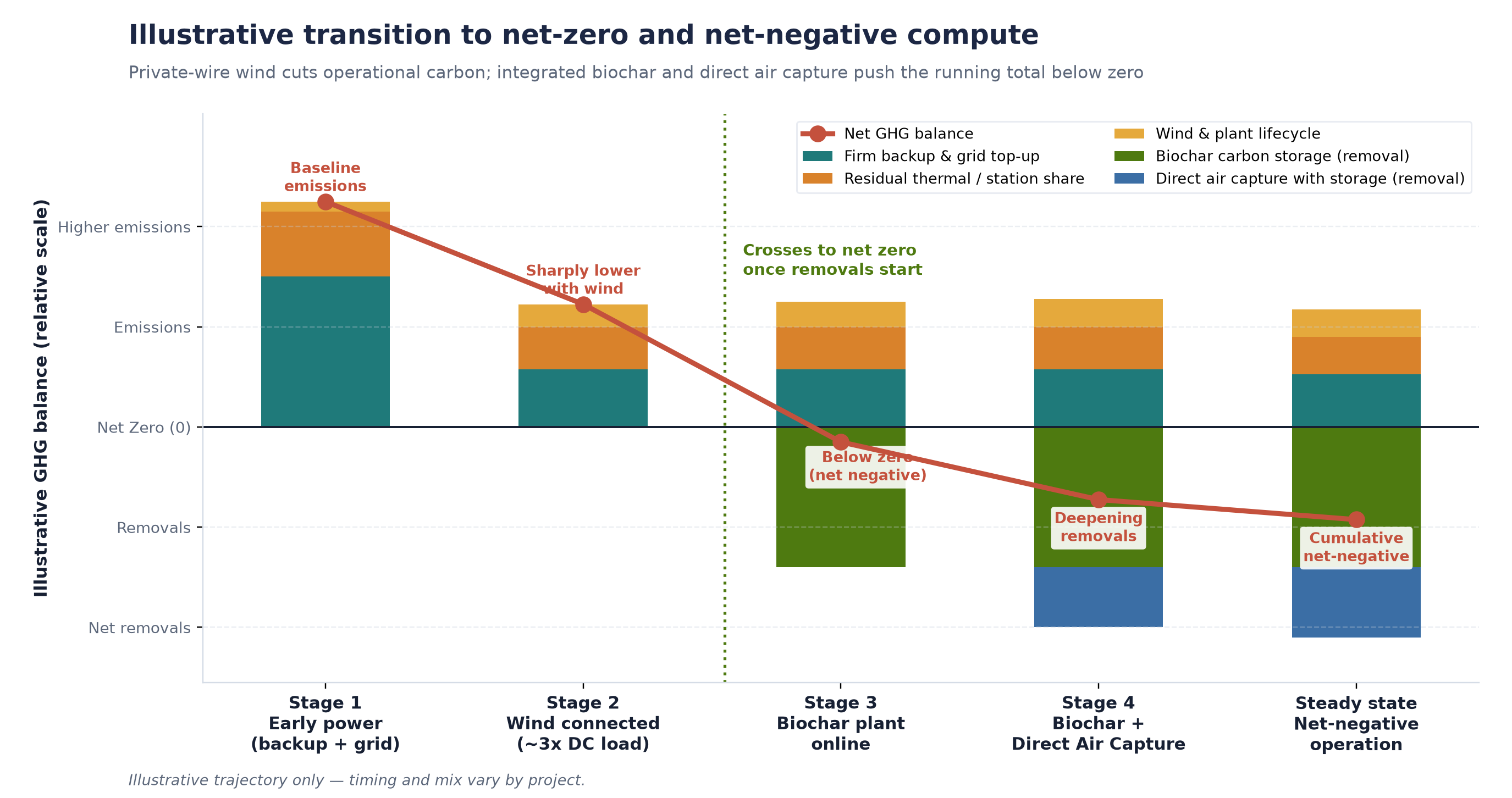
Transition to net zero and beyond. Connecting behind-the-meter wind cuts operational carbon significantly. Once integrated biochar storage and direct air capture come online, total removals exceed remaining emissions and the cumulative carbon balance moves below zero.
The same community-first model is being explored in three regions, each adapted to local wind resource, industry, transport links and the chance to leave a lasting public benefit.
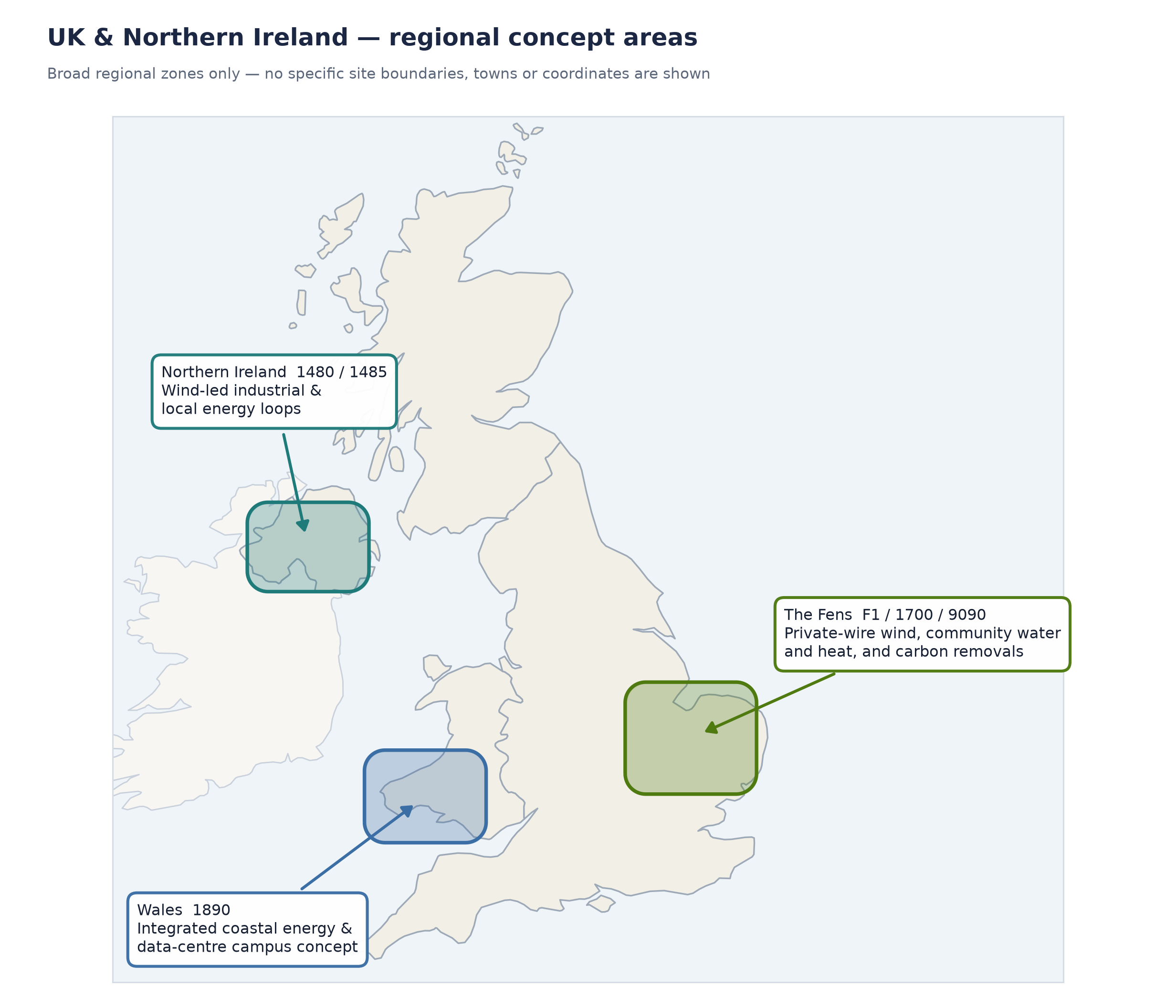
Broad regional areas where Net Zero Data and wind-led integrated energy concepts are being developed: Northern Ireland (1480 / 1485), Wales (1890) and The Fens (F1 / 1700 / 9090). Boundaries shown are purely regional.
Every region brings distinct strengths — from constrained industrial networks that benefit from co-located wind, to coastal brownfield hubs with port and rail infrastructure, to high-yield agricultural basins where community water and heat, and wind energy, align.
In western Northern Ireland, concepts focus on pairing new onshore wind directly with major local energy users in manufacturing, food production and quarrying, alongside supportive local landowners.
In South-West Wales, concepts centre on transforming brownfield industrial land with deep-water port access and retained rail freight infrastructure into a multi-vector net-zero compute and energy campus that serves the community around it.
Across the Fens in East Anglia, clustered onshore wind is designed to connect behind the meter over private 132 kV circuits to data-centre campuses and existing renewable biomass generation.
We work with landowners, local authorities, community groups, industrial off-takers and infrastructure partners across the UK and Northern Ireland. Get in touch to discuss how a data centre can help build a more sustainable community in your region.